

Wall Street Journal Distills What’s at Stake in The Buckeye Institute’s Two Blockbuster Home Distilling Cases
Apr 21, 2026Columbus, OH – In a hot-off-the-press editorial, The Wall Street Journal features both of The Buckeye Institute’s companion cases challenging the federal government’s ban on home distilling.
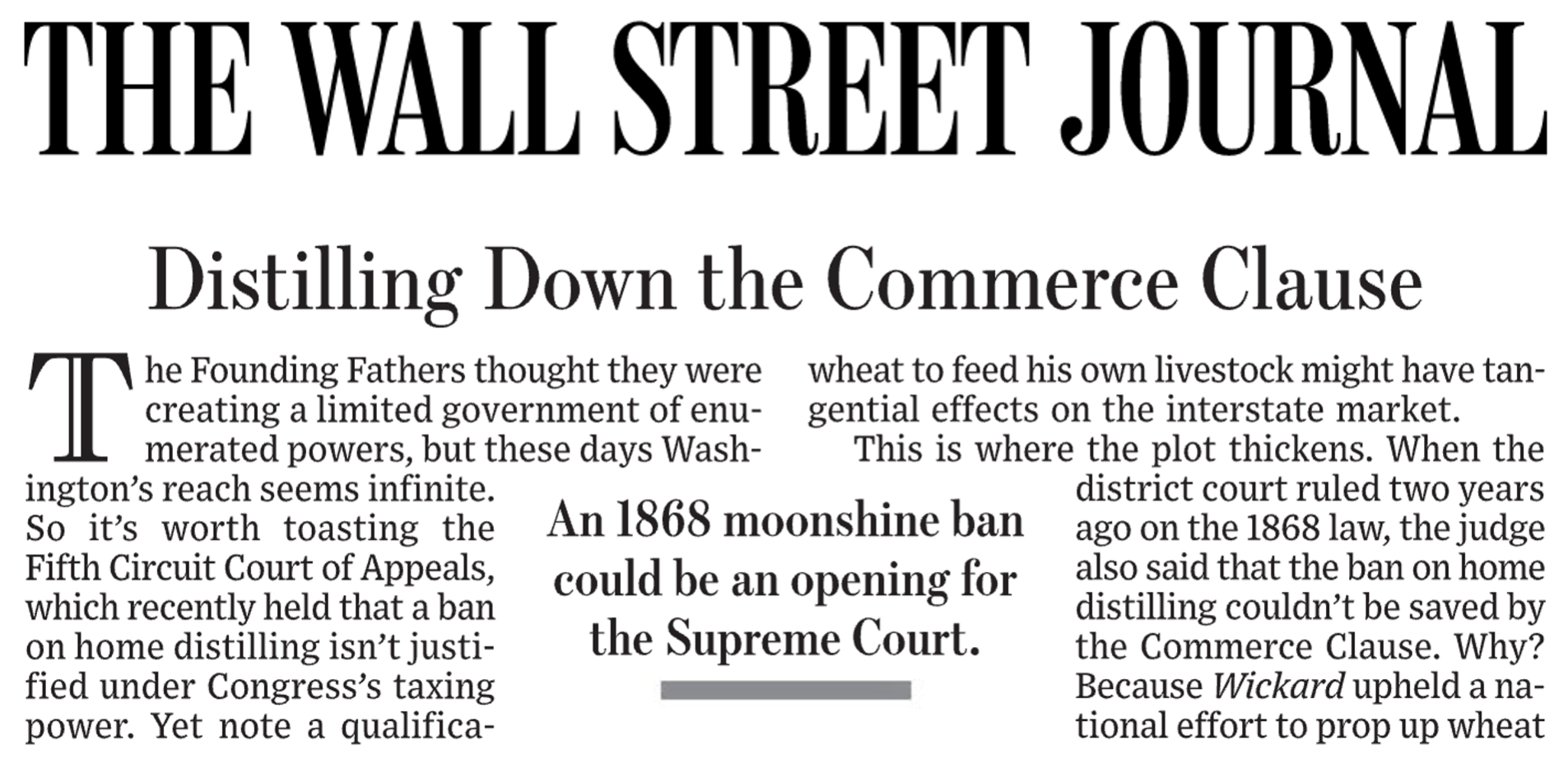
The Journal toasted The Buckeye Institute’s monumental win in McNutt v. U.S. Department of Justice, wherein the U.S. Court of Appeals for the Fifth Circuit recently ruled that the federal “ban on home distilling isn’t justified under Congress’s taxing power” and pointed out what many other media stories have missed… that the government sidestepped Buckeye’s challenge to the Commerce Clause.
“The fly in this tasty beverage, however, is the Commerce Clause… The informed speculation is that the Justice Department wanted to avoid giving the Fifth Circuit—and then the Supreme Court—an opening to reconsider the limits of the Commerce Clause.”
But as legendary sports announcer Lee Corso was known for quipping, “Not so fast, my friend.”
In Buckeye’s even bigger case pending before the U.S. Court of Appeals for the Sixth Circuit, Ream v. U.S. Department of the Treasury, the Commerce Clause issue remains alive and well.
The Journal also noted that the U.S. Supreme Court will most likely have an opportunity to address the Commerce Clause, writing:
“The Justices might soon get that opportunity anyway, since a similar dispute, Ream v. U.S. Dept. of the Treasury, is percolating in the Sixth Circuit. ‘John Ream is seeking to engage in a hobby that is as American as apple pie, and certainly a lot older: home distilling,’ his filing said. He wants to make ‘small quantities’ of whiskey ‘solely for his and his wife’s personal consumption.’”
“The Fifth Circuit ruling was a victory for the Constitution. The Sixth Circuit can do one better by setting up the Commerce Clause for another review by the Justices.”
Read the full Wall Street Journal editorial below.
To learn more about Ream v. U.S. Department of Treasury, visit: BuckeyeInstitute.org/ReamvUSTreasury. To learn more about McNutt v. U.S. Department of Justice, visit: BuckeyeInstitute.org/McNuttvDOJ.
# # #

Distilling Down the Commerce Clause
An 1868 moonshine ban could be an opening for the Supreme Court.
The Wall Street Journal
By The Editorial Board
April 20, 2026
The Founding Fathers thought they were creating a limited government of enumerated powers, but these days Washington’s reach seems infinite. So it’s worth toasting the Fifth Circuit Court of Appeals, which recently held that a ban on home distilling isn’t justified under Congress’s taxing power. Yet note a qualification on the ruling that media commentators missed.
The 1868 law in question prohibits any “distilled spirits plant” in a “dwelling house” or associated shed or yard. It was challenged by several aspiring tinkerers and the Hobby Distillers Association. In 2024 a district court ruled in their favor, saying the law is without constitutional basis. The government appealed, claiming the ban is needed to enforce spirits taxation, since home distillation is easy to conceal.
The Fifth Circuit soundly rejects that argument. “Preventing activity lest it give rise to tax evasion places no limit whatsoever on Congress’s power under the taxation clause,” Judge Edith Jones writes for the unanimous panel in McNutt v. U.S. Department of Justice. “In contrast, all of the other statutory provisions governing the manufacture, bottling, and labelling of distilled spirits exist to facilitate collection of taxes associated with the activity.”
So far so good. The fly in this tasty beverage, however, is the Commerce Clause, the constitutional provision that says the government may regulate commerce “among the several States.” It has been stretched for decades, the key precedent being Wickard v. Filburn, a 1942 case in which the Supreme Court said a farmer growing wheat to feed his own livestock might have tangential effects on the interstate market.
This is where the plot thickens. When the district court ruled two years ago on the 1868 law, the judge also said that the ban on home distilling couldn’t be saved by the Commerce Clause. Why? Because Wickard upheld a national effort to prop up wheat prices, while the distilling rule isn’t part of a comprehensive scheme to regulate liquor supply and demand.
What does the Fifth Circuit think? Well, as Judge Jones explains in a footnote: “The government does not challenge the district court’s Commerce Clause analysis on appeal. Accordingly, any such argument is forfeited, and we do not address it.” Curious. The informed speculation is that the Justice Department wanted to avoid giving the Fifth Circuit—and then the Supreme Court—an opening to reconsider the limits of the Commerce Clause.
The Justices might soon get that opportunity anyway, since a similar dispute, Ream v. U.S. Dept. of the Treasury, is percolating in the Sixth Circuit. “John Ream is seeking to engage in a hobby that is as American as apple pie, and certainly a lot older: home distilling,” his filing said. He wants to make “small quantities” of whiskey “solely for his and his wife’s personal consumption.” In that case, the district court held that Mr. Ream lacked standing, but the appeals panel asked for briefing on the merits.
The Fifth Circuit ruling was a victory for the Constitution. The Sixth Circuit can do one better by setting up the Commerce Clause for another review by the Justices.
Appeared in the April 21, 2026, print edition as ‘Distilling Down the Commerce Clause.’
# # #